



Yes, our inventory is accurate!
 Qualifies for Free Ground Economy Shipping (CONUS Only)
A grab-and-go astrograph that weighs just 5.5 pounds
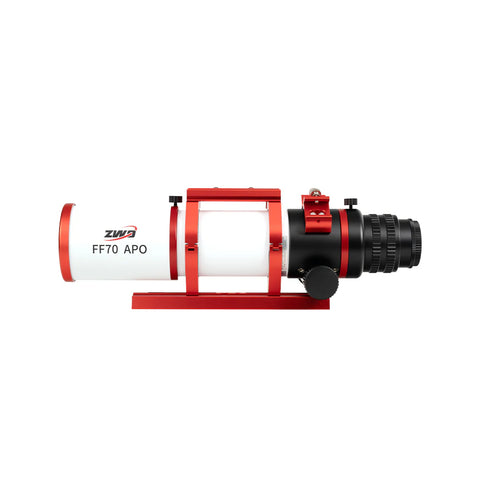
The ZWO FF70 APO is a 70mm f/7 quadruplet apochromatic refractor with a built-in field flattener and a full-frame 44mm image circle. It's the scope we suggest for a first dedicated astrophotography setup: wide enough to frame big nebulae and the Milky Way, light enough for a compact mount, and with no flattener spacing to get wrong. It works just as well for wide-field visual observing.
Key specs: 70mm aperture · 490mm f/7.0 · 44mm full-frame image circle · built-in field flattener · 2.5kg (5.5lb) tube · 2.4" dual-speed rack-and-pinion focuser
Questions about building a setup around it? Our team is happy to help.

What you can image and see
- Large nebulae: the North America and Pelican nebulae, the Heart and Soul, the Rosette and the Veil Nebula complex fit comfortably in one frame.
- Big galaxies: the Andromeda Galaxy with both companions, and the Triangulum Galaxy.
- Milky Way fields: rich star clouds in Cygnus, Sagittarius and Scutum.
- Visual: wide, sharp views of star clusters like the Double Cluster and the Pleiades, plus crisp low-power views of the Moon.
No flattener, no spacing math
Most refractors need a separate field flattener set at an exact distance from the sensor. The FF70 APO's four-element, air-spaced design (with one ED element) has the flattener built in, so there's no back focus to calculate: as long as your camera and adapters add no more than 82.5mm behind the M48 thread, you'll reach focus with sharp stars to the corners. The included photography extension tube and M48/M54 adapters connect dedicated astronomy cameras, DSLRs and mirrorless cameras, and the 360° rotator lets you frame your target without touching focus.
What to add for the best results
- A mount (required): the ZWO AM3N is a great match. Or save time with the ZWO 70APO + AM3N bundle.
- A camera: the ZWO ASI2600MC Pro (APS-C, cooled) is a popular pairing; the ZWO ASI533MC Pro is a great-value cooled color camera with a square sensor.
- Guiding: the ZWO 30F5 Mini Guide Scope with an ASI120MM Mini guide camera mounts right on the handle.
- Control and focus: the ASIAIR PLUS runs the whole rig from your phone, and the ZWO EAFN electronic focuser keeps stars sharp as the temperature drops.
- Filters: for city and suburban skies, a ZWO Duo-Band filter in a ZWO M54 2" filter drawer cuts light pollution on nebulae.
- For visual use: a 2" star diagonal like the Celestron 2" Dielectric Star Diagonal plus your eyepieces.
FF70 APO vs. the other ZWO FF refractors
| FF70 APO | FF90 APO | FF110 APO | FF131 APO | |
|---|---|---|---|---|
| Aperture | 70mm | 90mm | 110mm | 131mm |
| Focal length | 490mm (f/7.0) | 609mm (f/6.8) | 766mm (f/7.0) | 983mm (f/7.5) |
| Field of view, APS-C | 2.7° × 1.8° | 2.2° × 1.5° | 1.8° × 1.2° | 1.4° × 0.9° |
| Field of view, full frame | 4.2° × 2.8° | 3.4° × 2.3° | 2.7° × 1.8° | 2.1° × 1.4° |
| Tube weight | 2.5kg (5.5lb) | 3.92kg (8.6lb) | 5.74kg (12.7lb) | 7.9kg (17.4lb) |
| Focuser | 2.4" | 3" | 3" | 3" |
| Best for | Lightest, widest field; best first astrograph | Best balance of reach and portability | Galaxies and detail on a portable mount | Maximum reach for small galaxies |
Still deciding? Browse all our refractor telescopes or the full ZWO telescope lineup.
What's in the box
- FF70 APO optical tube with handle, tube rings and dovetail plate
- Photography extension tube with M48 and M54 adapters
Mount, camera, diagonal and eyepieces are sold separately.
ZWO FF70 APO FAQ
Do I need a field flattener with the FF70 APO?
No. The flattener is built into the optics, so stars stay sharp to the corners of a full-frame sensor, and there's no exact back focus to hit: as long as your camera and adapters add no more than 82.5mm behind the M48 thread, you'll reach focus.
Which camera works best with the FF70 APO?
An APS-C sensor like the ASI2600MC Pro gives about a 2.7° × 1.8° field at 490mm, ideal for large nebulae. A full-frame sensor gives an even wider 4.2° × 2.8° field and is fully covered by the 44mm image circle. DSLR and mirrorless cameras also work with the matching T-ring.
What mount do I need for the FF70 APO?
At 3.0kg (6.6lb) with rings and dovetail, the FF70 APO is an easy load for a compact harmonic mount like the ZWO AM3N, even with a camera, guide scope and ASIAIR attached. Lighter star-tracker mounts can carry it for short exposures, but a true equatorial mount gives far better results. See the ZWO 70APO + AM3N bundle for a matched setup.
Can I use the FF70 APO for visual observing?
Yes. The focuser accepts 1.25" and 2" accessories, so add a star diagonal and eyepieces. The color-free optics give crisp views of the Moon, planets and star clusters.
FF70 or FF90?
The FF70 is lighter, frames bigger targets and works on smaller mounts. The FF90 gathers about 65% more light and its longer 609mm focal length suits mid-size galaxies and nebulae. If portability and wide fields matter most, choose the FF70; if you want more reach from one scope, step up to the FF90.
Specifications
| Optics | |
|---|---|
| Optical design | Four-element air-spaced apochromat (one ED element), built-in field flattener |
| Aperture | 70mm |
| Focal length | 490mm |
| Focal ratio | f/7.0 |
| Image circle | 44mm (full frame) |
| Mechanical | |
| Focuser | 2.4" dual-speed rack-and-pinion, 1:10 fine focus, 360° rotator |
| Back focus | Up to 82.5mm from the M48x0.75 thread, or 100.5mm from the M54x0.75 thread (focuser retracted) |
| Rear adapters | M64x0.75-M54x0.75, M54x0.75-M54x0.75, M54x0.75-M48x0.75 (built-in M48 filter thread) |
| Dovetail | 230mm dovetail plate |
| Dew shield | Retractable |
| Physical | |
| Overall length | 372.5mm (1.25" interface retracted) to 473.4mm (photography extension tube extended) |
| Optical tube weight | 2.5kg (5.5lb) |
| Standard configuration weight | 3.0kg (6.6lb) with handle, tube rings and dovetail |
| ZWO model | FF70-APO |