



Yes, our inventory is accurate!
 Qualifies for Free Ground Economy Shipping (CONUS Only)
An affordable first guide camera that slides into a guide scope like an eyepiece
Why we like the ASI120MM Mini:
- Low cost of entry: it's ZWO's entry-level guide camera, an easy way to add guiding to a first imaging rig without a big spend.
- Sensitive where it counts: the monochrome AR0130CS sensor peaks at about 80% QE, so a 30mm to 50mm guide scope shows plenty of usable stars in most of the sky.
- Built for guiding: the 1.25" barrel slides into a guide scope's focuser, with room to slide it in or out to reach focus. A USB-C port connects to an ASIAIR or laptop, and an ST4 port can send corrections straight to the mount.
- Worth knowing: its small 1/3" sensor works best in a guide scope. For an off-axis guider, or if you want more stars to choose from, step up to the ASI220MM Mini.
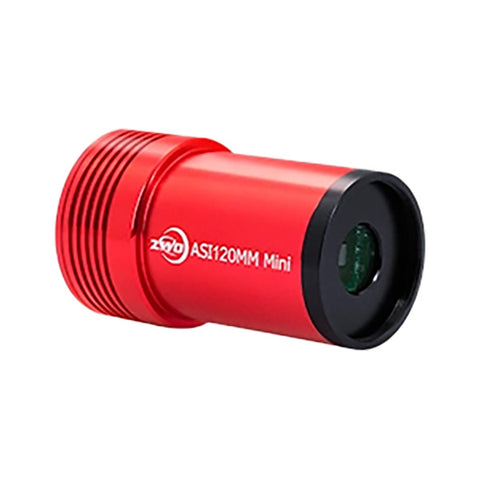
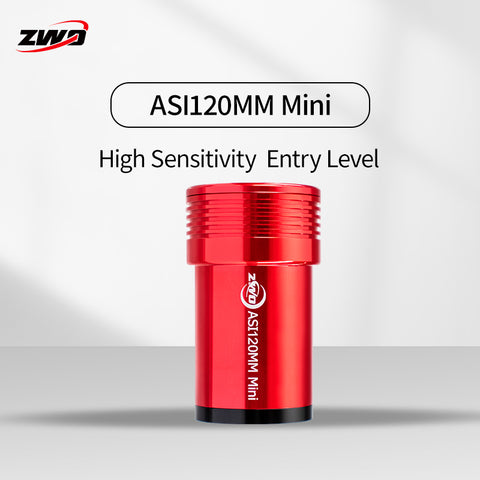
The ZWO ASI120MM Mini is a monochrome guide camera that keeps your mount on target during long astrophotography exposures. It watches a star through a guide scope and tells the mount how to correct its tracking many times a minute, so your stars stay round. It uses a 1/3" AR0130CS sensor with 1280 x 960 pixels of 3.75µm, and it weighs just 60g (2.1oz).
Key specs: 1/3" AR0130CS mono sensor (4.8 x 3.6mm) · 1280 x 960, 3.75µm pixels · read noise 4.0e · QE about 80% · 12-bit ADC · 35 fps · USB-C (USB 2.0) and ST4 · 1.25" barrel · 60g

What it does for your images
- Round stars in long exposures: guiding corrects small tracking errors so you can expose for minutes instead of seconds.
- Dithering: with the ASIAIR or PHD2, the guider shifts the frame slightly between exposures, which removes walking noise from stacked images.
- Faster polar alignment: the ASIAIR and PHD2 can use the guide camera for their polar alignment routines.
- Lighter rigs: at 60g it adds almost nothing to a small refractor on a strain-wave mount or star tracker.
How to set it up
Slide the camera into your guide scope's 1.25" focuser, focus on a star, and connect the USB-C cable to your ASIAIR or computer. In the ASIAIR app or PHD2, calibrate once and start guiding. If your mount has an ST4 autoguider port, the included ST4 cable can send corrections directly, though most setups now guide over the mount's USB connection.
With the ZWO 30F5 (150mm focal length), the ASI120MM Mini sees a 1.8° x 1.4° field at about 5.2 arcseconds per pixel, a comfortable match for most refractor imaging setups.
What to add for the best results
- ZWO 30F5 Mini Guide Scope (or another guide scope, required): the camera needs optics to look through.
- ZWO ASIAIR Plus 256GB: runs guiding, your main camera and the mount from your phone.
- William Optics UniGuide 32: a slide-base guide scope for William Optics refractors with a slide-base handle.
- William Optics UniGuide 50: a larger 50mm guide scope that gathers more light for fainter guide stars.
ASI120MM Mini vs. other ZWO guide cameras
| ASI120MM Mini | ASI220MM Mini | ASI174MM Mini | |
|---|---|---|---|
| Sensor | 1/3" AR0130 | 1/1.8" SC2210 | 1/1.2" IMX174 |
| Sensor size | 4.8 x 3.6mm | 7.68 x 4.32mm | 11.3 x 7.1mm |
| Resolution | 1280 x 960 | 1920 x 1080 | 1936 x 1216 |
| Pixel size | 3.75µm | 4µm | 5.86µm |
| Best for | Budget guiding with short guide scopes | Most guide scopes, and OAGs on refractors | OAGs on long focal length SCTs |
See all ZWO guide cameras and autoguiding gear.
What's in the box
- ASI120MM Mini camera
- 1.25" cover
- 1.25" extender
- M28.5 to CS adapter
- ST4 guide cable
- USB 2.0 Type-C cables, 0.5m and 2m
- Quick guide
The guide scope is sold separately.
ZWO ASI120MM Mini FAQ
Is it good for beginners?
Yes. Guiding sounds technical, but with an ASIAIR it's a few taps: focus the guide camera once, calibrate, and start. It's usually the second upgrade we suggest after a tracking mount and imaging camera.
ASI120MM Mini or ASI220MM Mini?
The ASI220MM Mini has about twice the sensor area and much lower read noise, so it finds guide stars more easily and works with an off-axis guider. The ASI120MM Mini does the job well in a guide scope if you're on a budget.
Which guide scope should I use?
A 30mm to 50mm guide scope with 120mm to 200mm focal length works well, such as the ZWO 30F5 or a UniGuide 32. For an off-axis guider, choose a camera with a larger sensor, like the ASI220MM Mini.
Does it work with the ASIAIR?
Yes. Plug it into one of the ASIAIR's USB ports and select it as the guide camera.
Can I use it as an imaging camera?
It's designed for guiding. It can take simple mono shots of the Moon, but for planets choose a USB 3.0 planetary camera such as the ASI585MC, and for deep-sky images a cooled camera such as the ASI2600MC Pro.
Specifications
| Sensor | |
|---|---|
| Sensor | onsemi AR0130CS, monochrome CMOS |
| Format | 1/3" (4.8 x 3.6mm) |
| Resolution | 1280 x 960 (1.2MP) |
| Pixel size | 3.75µm |
| Performance | |
| Read noise | 4.0e |
| Peak QE | About 80% |
| Full well | 13,000e |
| ADC | 12-bit |
| Frame rate | 35 fps at full resolution |
| Exposure range | 64µs to 2000s |
| Physical and connections | |
| Interface | USB-C (USB 2.0) |
| Guide port | ST4 |
| Barrel | 1.25" |
| Protective window | AR-coated |
| Back focus | 8.5mm |
| Size | 36mm diameter x 61mm |
| Weight | 60g (2.1oz) |
| Warranty | 2 years (ZWO) |
| Model / SKU | ZWO-ASI120MINI |