



 Qualifies for Free Ground Economy Shipping (CONUS Only)
The Seestar for smaller galaxies and finer nebula detail
Why we like the S50 Pro:
- More detail than the S30 Pro, more sky than the old S50: its 50mm lens gathers about 2.8× the light of the 30mm Seestars, and the new 4K sensor nearly doubles the original S50's field of view (2.8° vs. 1.46°).
- Tracking owners notice: with the near-zero-backlash drive and Equatorial Mode, owners commonly report keeping 90–100% of their 30-second frames.
- Lasts the whole night: a 10,000mAh battery runs about 9 hours, enough for a long winter night or a Plan-mode session that hops between several targets.
- Worth knowing: like every Seestar, the camera and filters are built in and can't be swapped, and very large mosaics run best on a phone or tablet with at least 8GB of RAM.
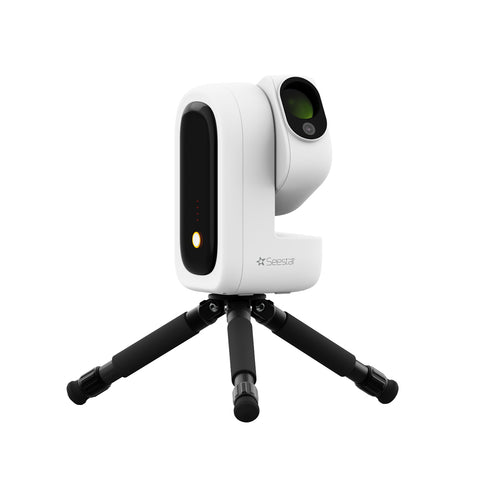
The ZWO Seestar S50 Pro is an all-in-one smart telescope: a 50mm apochromatic telescope, a 4K camera, a second wide-angle camera and a GoTo mount in one 2.8kg (6.2lb) unit you control from your phone. Choose a target, and it aligns, finds, focuses, tracks and stacks for you, with the picture getting clearer on your screen as the exposure builds. It's our pick for beginners who want the most detail a Seestar can give, and for experienced imagers who want a simple second setup with FITS files and ASCOM Alpaca support.
Key specs: 50mm f/5.2 four-element APO with ED glass · 4K 1/1.2" telephoto camera · 4K wide-angle camera (63°) · 2.8° telephoto field · built-in dual-band light pollution filter · Equatorial Mode · 10,000mAh battery (about 9 hours) · 128GB storage · 2.8kg (6.2lb)

What you can capture
- Galaxies: the Whirlpool, Pinwheel, Sombrero and Bode's Galaxies, M81 and M82, and the core and dust lanes of the Andromeda Galaxy.
- Nebulae: the Orion, Crescent, Eagle, Dumbbell and Ring Nebulae. The built-in dual-band filter brings out emission nebulae even from city skies.
- Bigger targets in mosaic: the app stitches several frames into images up to 8K for the whole Andromeda Galaxy, the North America Nebula or the Veil.
- The Milky Way and star trails: with the wide-angle camera, including landscape shots that keep the foreground sharp.
- The Moon and the Sun: crater detail, eclipses, and sunspots with the included solar filter.
- Daytime: birds, wildlife, distant mountains and rocket launches.

Why it's so easy to use
Pair your phone by tapping it on the S50 Pro (NFC), choose a target from the app's list or ask the built-in AI assistant, and tap GoTo. The S50 Pro calibrates itself, plate-solves to find where it's pointing, focuses and starts stacking. One tap applies processing, or you can adjust stretch, noise and color yourself.
When you want more, Plan mode queues targets for the whole night, remote control lets you run it from indoors, Equatorial Mode allows longer exposures (with a wedge, below), and ASCOM Alpaca connects it to software like N.I.N.A.
Using the S50 Pro in Colorado
- Front Range light pollution: from Denver and its suburbs, the dual-band filter handles emission nebulae well. Galaxies are worth a drive to a darker site.
- Dark skies within a drive: Jackson Lake State Park, Florissant Fossil Beds and Westcliffe and Silver Cliff are all certified dark-sky places within about two hours of Denver.
- Cold nights: ZWO rates the S50 Pro down to -10°C (14°F), and mountain sites get colder in winter. Keep it in a warm car between sessions; the 9-hour battery helps when cold drains it faster.
What to add for the best results
- Seestar Fluid Head with Tripod (EQ wedge and tripod): everything you need for Equatorial Mode on a steadier, full-height stand.
- Seestar TH10 Fluid Tripod Head: the EQ wedge on its own, for use on the Seestar TC20 tripod or another full-height tripod. Add a TH10 quick release plate for fast mounting.
- Precision Tripod Leveler: quick, accurate leveling on uneven ground.
Seestar S50 Pro vs. S30 Pro vs. original S50
| Seestar S50 Pro | Seestar S30 Pro |
Seestar S50 (original) Discontinued |
|
|---|---|---|---|
| Aperture / focal length | 50mm / 260mm | 30mm / 160mm | 50mm / 250mm |
| Optics | 4-element APO with ED glass | 4-element APO with ED glass | Triplet APO |
| Main camera | 4K, 1/1.2" | 4K, 1/1.2" | Full HD, 1/2.8" |
| Telephoto field of view | 2.8° | 4.6° | 1.46° |
| Wide-angle camera | Yes, 4K | Yes, 4K | No |
| Battery | 10,000mAh (about 9 hours) | 6,000mAh (about 6 hours) | 6,000mAh (about 6 hours) |
| Weight | 2.8kg (6.2lb) | 1.65kg (3.6lb) | 2.5kg (5.5lb) |
| Best for | Smaller galaxies, nebula detail and the Moon | Large nebulae, the Milky Way and travel | Sometimes in our used smart telescopes |
Choose the S50 Pro for the most detail and the longest battery life in the Seestar line. Choose the S30 Pro if you want a wider view and a lighter, cheaper scope for travel. See the whole ZWO Seestar lineup.
What's in the box
- Seestar S50 Pro smart telescope
- Tripod (standard 3/8"-16 thread, adjustable angle)
- Magnetic solar filter
- USB-C cable
- Protective case
- Quick-start guide and safety information

Full-height tripod and EQ wedge are sold separately.
Seestar S50 Pro FAQ
Is the Seestar S50 Pro good for beginners?
Yes. The app handles alignment, finding targets, focusing, tracking and processing, and the AI assistant answers questions as you go. Plan mode, Equatorial Mode and ASCOM Alpaca give you room to grow.
Seestar S50 Pro or S30 Pro?
The S50 Pro's 50mm lens gathers about 2.8× more light, so it shows smaller, fainter galaxies and more nebula and lunar detail, and its battery lasts longer. The S30 Pro has a wider 4.6° view for big nebulae and the Milky Way, and it's lighter and costs less.
How is it different from the original S50?
The S50 Pro has a 4K sensor instead of Full HD, nearly twice the field of view, a second wide-angle camera, a four-element APO lens, 128GB of storage instead of 64GB, and a 9-hour battery instead of 6.
Can I see Saturn and Jupiter?
Yes. Saturn's rings and Jupiter's cloud bands and moons are visible, but planets are small at 260mm focal length. The S50 Pro does best on the Moon and deep-sky objects.
What do I need for Equatorial Mode?
An EQ wedge like the Seestar TH10 on a full-height tripod. The Fluid Head with Tripod bundle includes both.
Does it work under city light pollution?
Yes, especially on emission nebulae, where the built-in dual-band filter cuts through city glow. Galaxies and star clusters look best from darker skies.
Can I look through it with an eyepiece?
No. Like all smart telescopes, it's camera-based, and you view images on your phone or tablet.
Can I photograph the Sun?
Yes, with the included magnetic solar filter attached. Never point the S50 Pro at the Sun without the filter in place.
Specifications
| Optics | |
|---|---|
| Optical design | 4-element apochromatic refractor with ED glass |
| Aperture | 50mm (telephoto); 3.4mm (wide-angle) |
| Focal length | 260mm (telephoto); 6mm (wide-angle) |
| Focal ratio | f/5.2 (telephoto); f/1.75 (wide-angle) |
| Field of view | 2.8° (telephoto); 63° (wide-angle) |
| Focus range | 15m to infinity (telephoto) |
| Cameras and filters | |
| Telephoto sensor | OmniVision OS08B10, 1/1.2", 2.9µm pixels, 8.3MP (3840 × 2160) |
| Wide-angle sensor | Sony IMX586, 1/2", 1.6µm pixels, 8.3MP (3840 × 2160) |
| Built-in filters | UV/IR cut; dual-band light pollution (OIII 30nm / H-alpha 20nm); dark field |
| Solar filter | Magnetic, included |
| Image and video formats | JPEG, FITS; MP4, AVI |
| Mount and tracking | |
| Mount | Motorized alt-azimuth GoTo; Equatorial Mode with an optional wedge |
| Slew rate | 1× to 1440× |
| Tripod thread | 3/8"-16 |
| Power, storage and connectivity | |
| Battery | 10,000mAh; up to about 9 hours (ZWO lab figure) |
| Power input | USB-C, 5V 3A or 12V 3A |
| Storage | 128GB eMMC |
| Connectivity | Wi-Fi (2.4 / 5 GHz), Bluetooth, NFC, USB-C; Seestar app for iOS and Android |
| Software support | ASCOM Alpaca (N.I.N.A. and others) |
| Physical | |
| Weight | 2.8kg (6.2lb) |
| Dimensions (folded) | 140 × 149 × 268mm (5.5 × 5.9 × 10.6 in) |
| Operating temperature | -10°C to 40°C (14°F to 104°F) |
| Model / SKU | SEESTAR-S50-PRO |
Manuals and quick guides: ZWO Seestar guides and manuals.