



Yes, our inventory is accurate!
 Qualifies for Free Ground Economy Shipping (CONUS Only)
A cooled color camera, guider and ASIAIR in one small body
Why we like the ASI585MC Air:
- The lowest-cost way into a cooled ASIAIR setup: one $999 body holds a cooled color IMX585 camera, a separate guide sensor and a full ASIAIR with 256GB of storage. There's no guide scope, controller or laptop to buy or mount.
- Color in one shot: no filter wheel or LRGB filters to manage, so a whole night's data is one set of frames you can live stack in the app and process with simple tools.
- Clean, low-noise data: the STARVIS 2 sensor has zero amp glow and read noise as low as 0.7e⁻, and two-stage cooling holds it 30–35°C below ambient for matching dark frames.
- Worth knowing: the sensor is small (11.2 × 6.3mm), so it frames galaxies and smaller nebulae better than big wide fields. A dual-band filter dims the guide stars too, and since everything is in one unit, if it needs service your whole rig is down.
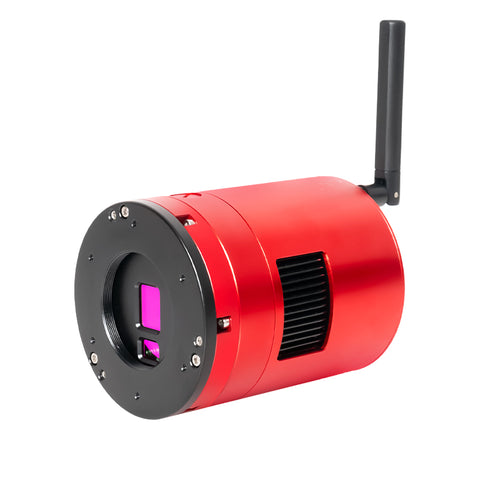
The ZWO ASI585MC Air is a wireless smart deep-sky camera that combines three devices: a cooled one-shot-color camera built on Sony's 8.3MP STARVIS 2 IMX585 sensor, an SC2210 guide sensor, and an ASIAIR controller with 256GB of storage. You run the camera, mount, guiding, focuser and plate solving from the ASIAIR app on a phone or tablet. It suits imagers stepping up from a smart telescope or a DSLR who want a simple, compact rig on a small refractor. The body is 78mm across and 108mm tall, and weighs 620g (1.4lb).
Key specs: Sony IMX585 STARVIS 2 color sensor, 1/1.2" (11.2 × 6.3mm) · 8.3MP (3840 × 2160) · 2.9µm pixels · read noise 0.7–6.67e⁻ · zero amp glow · two-stage cooling 30–35°C below ambient · built-in guide sensor (SC2210, 0.6e⁻) · built-in ASIAIR, 256GB · dual-band Wi-Fi and Bluetooth · 620g

What you can image
- Galaxies: the Whirlpool, Pinwheel, Sunflower and Black Eye Galaxies, M81 and M82, and the Leo Triplet. On the 490mm ZWO FF70 the field is about 1.3° × 0.7° at 1.2″ per pixel.
- Nebulae in color: the Orion, Lagoon, Trifid, Eagle and Crescent Nebulae. Add a dual-band filter and emission nebulae come through from a light-polluted backyard.
- Planetary nebulae and clusters: the Ring, Dumbbell and Owl Nebulae, and the Hercules Cluster (M13) and Pleiades in natural color.
- Wider targets: on the 250mm RedCat 51 the field grows to about 2.6° × 1.4° at 2.4″ per pixel, enough for the Rosette, the Heart Nebula's core or the Andromeda Galaxy's bright center.
How it works
Mount the camera on your telescope, plug the mount, focuser and any other USB gear into its four USB 2.0 ports, and connect 12V power to either DC port (they also pass power on to other gear). The ASIAIR app connects over 2.4 or 5GHz Wi-Fi and walks you through polar alignment, focusing, plate solving, guiding and an imaging plan. Live stacking and simple editing in the app let you watch the image build, and you can also run the camera from a computer with ASIStudio or ASCOM Alpaca software (ASCOM Platform 6.6 or later). Images save to the 256GB of built-in storage or to a USB drive of up to 1TB.
The sensor sits 17.5mm behind the camera face, and the included 21mm and 16.5mm extenders bring it to the standard 55mm. The guide sensor needs a 36mm image circle, so ZWO recommends a telescope that covers APS-C or larger; a full-frame image circle gives the best guide stars. The sensor window has a UV/IR-cut coating, so you don't need a separate IR-cut filter.

Using it in Colorado
- City or dark site: shoot emission nebulae from home with a dual-band filter, and save galaxies and clusters for darker sites like Jackson Lake State Park or the Westcliffe area.
- Cold nights: the camera is rated to −20°C, runs from one 12V battery, and its cooler holds a set temperature as the night cools. Keep your phone warm, since it's your control screen.
- Wi-Fi range: ZWO rates it at 20m on 2.4GHz in open areas, so it works best from a backyard or right next to the car.
What to add for the best results
- 12V power (required): the ZWO 12V 5A adapter at home, or a PowerTank Lithium Pro in the field. It powers the camera and the gear plugged into it.
- A telescope that covers APS-C or larger: the ZWO FF70 (490mm, 44mm image circle) or the wider RedCat 51 (250mm). The FF70 + AM3N bundle adds a matching mount.
- A dual-band filter for city nebulae: the ZWO Duo-Band or Optolong L-eXtreme in the 2" size, held in a ZWO M42 2" filter drawer so you can swap it in and out without touching focus.
- ZWO EAFN electronic focuser: plugs into the camera and refocuses automatically as the temperature drops.
- A mount: the ZWO AM3N with TC40 tripod or the ZWO AM5N, both controlled directly by the built-in ASIAIR.
ASI585MC Air vs. ASI585MM Air vs. ASI2600MC Air
| ASI585MC Air | ASI585MM Air | ASI2600MC Air | |
|---|---|---|---|
| Main sensor | IMX585 color, 1/1.2" | IMX585 mono, 1/1.2" | IMX571 color, APS-C |
| Resolution | 8.3MP, 2.9µm pixels | 8.3MP, 2.9µm pixels | 26MP, 3.76µm pixels |
| Field on a 490mm refractor | 1.3° × 0.7° | 1.3° × 0.7° | 2.7° × 1.8° |
| Filters needed | None (dual-band optional) | Filter wheel and LRGB/narrowband filters | None (dual-band optional) |
| Built-in ASIAIR and guide sensor | Yes | Yes | Yes |
| Price | $999 | $1,299 | $1,999 |
| Best for | The simplest color setup at the lowest price | Narrowband and the most detail on small targets | Wide fields in color |
See all ZWO ASIAIR products and ZWO cooled deep-sky cameras.
What's in the box

- ASI585MC Air camera and camera bag
- External Wi-Fi antenna
- DC cable (1m) and DC male-female extension cable (1.5m)
- Two 0.5m USB 2.0 cables (Type-A to Type-B)
- T2 extender (21mm), T2-M48 extender (16.5mm) and M42-M48 tilter
- 1m hook-and-loop strap and 2mm (M2.5) hex wrench
- Quick guide and packing list
The 12V power supply, telescope, mount and filters are sold separately.
ZWO ASI585MC Air FAQ
Is the ASI585MC Air good for beginners?
Yes. It's one of the simplest ways into cooled deep-sky imaging: one camera to connect, no filter wheel, and the ASIAIR app walks you through each step. It's a natural next step after a Seestar or other smart telescope. You'll still need a mount, a small refractor and 12V power.
Color (MC) or mono (MM) Air?
Choose the MC for color in one shot with no filters to manage, at a lower price. Choose the ASI585MM Air if you want to shoot narrowband from light-polluted skies and don't mind a filter wheel and processing separate channels.
ASI585MC Air or ASI2600MC Air?
The ASI2600MC Air has a much larger APS-C sensor, about 2.1 times the field width on the same telescope, for big nebulae and the Andromeda Galaxy. The 585MC Air costs $1,000 less and is a good match for galaxies and smaller targets on short refractors.
Do I still need a guide scope or computer?
No. The guide sensor guides through your telescope like an off-axis guider, and the built-in ASIAIR runs everything from the free app on your phone or tablet.
Can it guide through a dual-band filter?
Yes, but the filter dims the guide stars too, since it sits in front of both sensors. A full-frame image circle, a fast telescope and slightly longer guide exposures all help. Use a 2" filter so it covers the 36mm circle both sensors need.
Can I image planets with it?
It isn't built for planets, since its frame rates are low for lucky imaging. For the Moon, Sun and planets, the ASI585MC planetary camera uses the same sensor at high speed.
Specifications
| Main sensor | |
|---|---|
| Sensor | Sony IMX585 STARVIS 2, back-illuminated, color |
| Format | 1/1.2", 11.2 × 6.3mm (13.2mm diagonal) |
| Resolution | 8.3MP, 3840 × 2160 |
| Pixel size | 2.9µm |
| ADC | 12-bit |
| Read noise | 0.7–6.67e⁻ (high-conversion-gain mode from gain 252) |
| Full well | 40,000e⁻ |
| Unity gain | 198 |
| Peak QE | 88% (ZWO lab estimate) |
| Amp glow | None |
| Exposure range | 32µs to 2000s |
| Max frame rate | 10.8 fps at 1920 × 1080 (RAW8) |
| Cooling | Two-stage TEC, 30–35°C below ambient (tested at 30°C ambient) |
| Anti-dew heater | 2.4W |
| Sensor window | UV/IR-cut coated (passes about 400–690nm) |
| Guide sensor | |
| Sensor | SC2210, 1/1.8" (7.68 × 4.32mm), mono |
| Resolution | 1920 × 1080, 4µm pixels |
| Read noise | 0.6–3.2e⁻ |
| Peak QE | 92% at 500nm |
| Frame rate | 8.5 fps |
| Built-in ASIAIR and connections | |
| Memory and storage | 2GB DDR4; 256GB eMMC; external USB drives up to 1TB |
| Wireless | Dual-band 2.4/5GHz Wi-Fi (802.11ac), 20m rated range; Bluetooth |
| Ports | 4 × USB 2.0, 1 × USB-C, 2 × 12V DC in/out |
| Power | 12V DC, 3A to 10A input; 24.6W maximum for the camera |
| Software | ASIAIR app; ASIStudio; ASCOM Alpaca (Windows, Linux, macOS) |
| Physical | |
| Mounting | M42 × 0.75 |
| Back focus | 17.5mm; 55mm with included extenders |
| Required image circle | 36mm (APS-C or larger telescope recommended) |
| Size | 78mm diameter × 108mm; antenna 94mm |
| Weight | 620g (1.4lb) |
| Operating temperature | −20°C to 50°C |
| Model / SKU | ASI585MC-Air |