



Yes, our inventory is accurate!
 Qualifies for Free Ground Economy Shipping (CONUS Only)
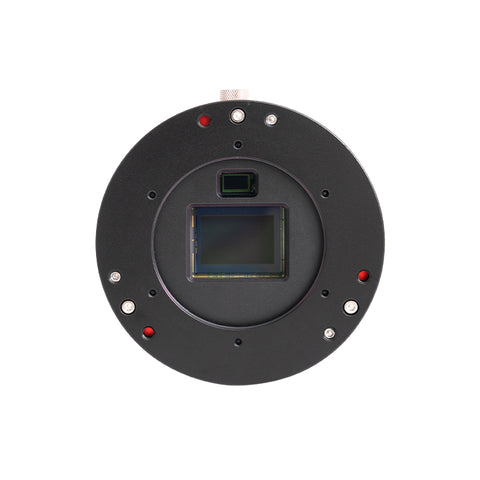
APS-C mono imaging with the ASIAIR and guider built in
Why we like the ASI2600MM Air:
- A proven mono sensor, far fewer parts: the same 26MP IMX571 mono sensor as the ASI2600MM Pro, plus a guide sensor and a full ASIAIR in one cooled body. Your filter wheel, focuser and mount plug straight into the camera.
- Narrowband from the city: with Ha, OIII and SII filters, a mono APS-C sensor pulls faint nebulae out of Front Range light pollution, and the 16-bit output and up to 73,000e⁻ full well keep bright star cores from clipping.
- Guiding through your telescope: the guide sensor sits beside the main sensor like a built-in off-axis guider, so there's no guide scope, OAG or guide camera to set up.
- Worth knowing: your filters sit in front of the guide sensor too, so you need 2" filters and a telescope with a full-frame image circle (43mm), and guide stars get fainter through narrowband filters. Everything lives in one unit, so if it needs service your whole rig is down.
The ZWO ASI2600MM Air is a wireless smart deep-sky camera that combines three devices: a cooled monochrome imaging camera built on Sony's 26MP APS-C IMX571 sensor, an SC2210 guide sensor, and an ASIAIR controller with 256GB of storage. You run the camera, filter wheel, focuser, mount, guiding and plate solving from the ASIAIR app on a phone or tablet. It's for imagers ready for LRGB and narrowband who want a wide APS-C field without a nest of cables and separate boxes. The body is 90mm across and 98mm tall, and weighs 775g (1.7lb).
Key specs: Sony IMX571 APS-C mono sensor (23.5 × 15.7mm) · 26MP (6248 × 4176) · 3.76µm pixels · 16-bit ADC · read noise 0.84–4.2e⁻ · cooling 30–35°C below ambient · built-in guide sensor (SC2210, 0.6e⁻) · built-in ASIAIR, 256GB · dual-band Wi-Fi and Bluetooth · 775g

What you can image
- Large nebulae in narrowband: the Heart and Soul, North America and Pelican, Veil, California and Rosette Nebulae. On the 250mm RedCat 51 the field is about 5.4° × 3.6° at 3.1″ per pixel.
- Bicolor and Hubble-palette targets: the Eagle Nebula and Pillars of Creation, the Elephant's Trunk, Crescent, Bubble and Pacman Nebulae, all workable from a Denver backyard in Ha, OIII and SII.
- Galaxies in LRGB: the Andromeda, Triangulum, Whirlpool and Pinwheel Galaxies and M81/M82. On the 490mm ZWO FF70 the field is about 2.7° × 1.8° at 1.6″ per pixel; on the 612mm FF90 it's 2.2° × 1.5° at 1.3″.
- Faint structure: the Squid Nebula (Ou4) inside the Flying Bat, and the faint outer loops of the Cygnus region, reward long OIII and Ha integrations.
How it works
Mount the camera on your telescope, plug the filter wheel, focuser and mount into its four USB 2.0 ports, and connect 12V power to any of the three DC ports; the other two feed 12V on to dew heaters or other gear. The ASIAIR app connects over 2.4 or 5GHz Wi-Fi (or Bluetooth for ZWO AM-series mounts) and walks you through polar alignment, focusing, plate solving, guiding and an imaging plan that steps through each filter. You can also run the camera from a computer with ASIStudio or ASCOM Alpaca software (ASCOM Platform 6.6 or later), and images save to 256GB of built-in storage or a USB drive of up to 1TB.
The sensor sits 17.5mm behind the M54 camera face, and the included 16.5mm and 21mm M54 extenders and M54-M48 ring bring it to the standard 55mm. A 2" filter wheel takes the place of some of those spacers. ZWO specifies a 43mm image circle to cover both sensors, so choose a telescope sold as full-frame compatible, such as the ZWO FF quadruplets (44mm).

Using it in Colorado
- Use the moon: narrowband filters let you keep imaging nebulae on moonlit nights and from the city, and save LRGB galaxies for dark sites like Jackson Lake State Park or the Westcliffe area.
- Cold nights: the camera is rated to −20°C and its cooler holds a set temperature as the night cools. Keep your phone warm, since it's your control screen.
- Wi-Fi range: ZWO rates it at 20m on 2.4GHz in open areas, so it works best from a backyard or right next to the car.
What to add for the best results
- 12V power (required): the ZWO 12V 10A adapter at home (the camera can feed a filter wheel, focuser and dew heaters), or a PowerTank Lithium Pro in the field.
- A 2" filter wheel (required for color): the ZWO EFW 7x2" holds LRGB plus Ha, OIII and SII; the ZWO EFW 5x2" holds LRGB plus Ha. Both plug into the camera's USB ports.
- Narrowband filters: the ZWO 7nm SHO set or Optolong SHO 7nm set, in the 2" size.
- LRGB filters: the Optolong LRGB set in 2" for galaxies and star clusters in natural color.
- ZWO EAFN electronic focuser: refocuses automatically between filters and as the temperature drops.
- A full-frame telescope and a mount: the ZWO FF90 or FF110 on a ZWO AM5N, which the built-in ASIAIR controls directly.
ASI2600MM Air vs. ASI2600MC Air vs. ASI2600MM Pro setup
| ASI2600MM Air | ASI2600MC Air | ASI2600MM Pro + ASIAIR Plus + guider | |
|---|---|---|---|
| Main sensor | IMX571 mono, APS-C | IMX571 color, APS-C | IMX571 mono, APS-C |
| Peak QE | About 91% | About 80% | About 91% |
| Filters needed | 2" filter wheel and LRGB/narrowband filters | None (dual-band optional) | Filter wheel and 36mm or 2" filters |
| Guiding | Built-in guide sensor | Built-in guide sensor | Separate ASI220MM Mini and OAG |
| Controller | Built-in ASIAIR, 256GB | Built-in ASIAIR, 256GB | Separate ASIAIR Plus or a computer |
| Price | $2,499 | $1,999 | About $2,825 for all four |
| Best for | Narrowband and LRGB with the simplest rig | Color in one shot, no filters | Any software, upgrading parts one at a time |
See all ZWO ASIAIR products and ZWO cooled deep-sky cameras.
What's in the box

- ASI2600MM Air camera and camera bag
- External Wi-Fi antenna
- Two 1m power cords and a 1.5m DC male-female extension cable
- Two 0.5m USB 2.0 cables
- 16.5mm M54 adapter, 21mm M54 extender and M54-M48 ring
- 1m cable strap and 2mm (M2.5) hex wrench
- Quick guide and packing list
The 12V power supply, filter wheel, filters, telescope and mount are sold separately.
ZWO ASI2600MM Air FAQ
Is the ASI2600MM Air good for beginners?
It's the simplest APS-C mono setup we sell, since the controller and guider are built in and the app walks you through each step. Mono imaging still means a filter wheel, filters and combining separate channels in processing, so if you're new to astrophotography, the color ASI2600MC Air is an easier start.
Mono (MM) or color (MC) Air?
Choose the MM for narrowband from light-polluted skies, the highest sensitivity and the sharpest detail per pixel. Choose the MC Air for color in one shot with no filter wheel, at $500 less.
ASI2600MM Air or ASI2600MM Pro?
Both use the same mono IMX571 sensor. The Air saves about $325 and a lot of cabling over buying the ASI2600MM Pro, an ASIAIR Plus, a guide camera and an OAG. The Pro makes sense if you want other capture software, already own an ASIAIR or guider, or want to use smaller, less expensive 36mm filters.
What size filters do I need?
2" filters. The filter sits in front of both the main and guide sensors, and ZWO specifies a 43mm image circle to cover both, which 36mm and 1.25" filters are too small for.
Can it guide through narrowband filters?
Yes, but narrowband filters dim the guide stars too. A fast telescope with a full-frame image circle and slightly longer guide exposures help.
Do I need a computer?
No. The built-in ASIAIR runs everything from the free ASIAIR app on a phone or tablet. You can still use ASIStudio, or NINA and other programs through ASCOM Alpaca, on a computer if you prefer.
Specifications
| Main sensor | |
|---|---|
| Sensor | Sony IMX571, back-illuminated, mono |
| Format | APS-C, 23.5 × 15.7mm (28.3mm diagonal) |
| Resolution | 26MP, 6248 × 4176 |
| Pixel size | 3.76µm |
| ADC | 16-bit |
| Read noise | 0.84–4.2e⁻ (1.4e⁻ at gain 100, where high-conversion-gain mode starts) |
| Full well | 50,000e⁻; up to 73,000e⁻ in extended mode (gain −25) |
| Peak QE | About 91% |
| Exposure range | 32µs to 2000s |
| Frame rate | 10.8 fps at 1920 × 1080; 36.4 fps at 320 × 240 |
| Cooling | Two-stage TEC, 30–35°C below ambient (tested at 30°C ambient) |
| Anti-dew heater | 3.6W |
| Sensor window | AR-coated |
| Guide sensor | |
| Sensor | SC2210, 1/1.8" (7.68 × 4.32mm), mono |
| Resolution | 1920 × 1080, 4µm pixels |
| Read noise | 0.6–3.2e⁻ |
| Peak QE | 92% at 500nm |
| Frame rate | 8.5 fps |
| Built-in ASIAIR and connections | |
| Memory and storage | 2GB DDR4; 256GB eMMC; external USB drives up to 1TB |
| Wireless | Dual-band 2.4/5GHz Wi-Fi (802.11ac), 20m rated range; Bluetooth |
| Ports | 4 × USB 2.0, 1 × USB-C, 3 × 12V DC (any one as input, the other two as outputs) |
| Power | 12V DC, 3A to 10A input; 27.6W maximum for the camera |
| Software | ASIAIR app; ASIStudio; ASCOM Alpaca (Windows, Linux, macOS) |
| Physical | |
| Mounting | M54 × 0.75 |
| Back focus | 17.5mm; 55mm with included extenders |
| Required image circle | 43mm (full-frame telescope recommended) |
| Size | 90mm diameter × 98mm; antenna 94mm |
| Weight | 775g (1.7lb) |
| Operating temperature | −20°C to 50°C |
| Model / SKU | ZWO-ASI2600MM-Air |