



 See It In Person - On Display In Our Showroom!
 Qualifies for Free Ground Economy Shipping (CONUS Only)
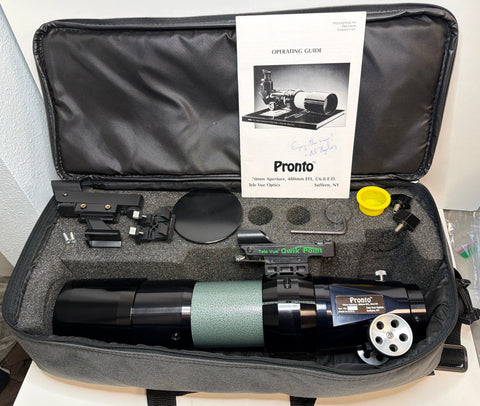
This is a green TV 70mm Pronto in very good condition, with reasonably clean optics and body. There are some small specks of dust on the inside of the objective that we have not been able to remove. See the photos. You may be able to blow these out yourself with additional air pressure. We have taken this very minor condition issue into consideration in the pricing.
It includes the clamshell and its original padded soft-sided case. It also includes the TV QwikPoint RDF, which works, but has seen better days - see the photos. To correct for this, we have also included a standard Celestron StarPointer RDF, with mounting plate and screws.
Does not include eyepiece or diagonal, which are available separately. We can ship this item.
Description
In March 1993 TeleVue introduced the 70mm "Pronto" ED doublet refractor telescope. Since then, the "Pronto" has become highly successful for birding (considered a "Reference Standard" in its class), and has been well accepted by the astronomy community too. The Pronto has the field of view and versatility for many uses; with a use able magnification of up to about 150X this will clearly identify the major planets. The "Pronto" has become a popular first (or second) telescope choice for several reasons:
- The "Pronto" is very compact, rugged, and simple to use (with an optional mount/tripod such as the "Panoramic" stand). So much so that it gets used more often than larger telescopes where quick set up or incidental considerations are high priorities. In its furnished carrying case, it is easily transported.
|
PERFORMANCEThe objective lens of the "Pronto" is an air spaced doublet design where two lenses are matched to work as one. The front element is a positive fluorocrown substitute of Extra-Low Dispersion ("ED") glass; the rear element is of high index flint. Each lens spherical surface is smoothly polished, and in another testament to Al Nagler's forward thinking - this design can be made well, consistently. This design allows good color correction and stars appear to snap into focus as intense diamonds against a black velour background - the typical high quality refractor experience! But at high magnifications some false violet may be noticed on very bright small objects (stars including Vega, the planet Venus for example) - but these objects are pretty harsh tests of any telescope. Images of birds and planets are presented showing good detail, and daytime objects viewed at commonly used magnifications will appear quite three dimensional, free of apparent false color, sharp and contrasty.The current production objective's four air to glass surfaces have anti-reflection coatings providing an overall light transmission greater than 94% in the visual wavelengths. So the system has about 93 times the light gathering power of the unaided human eye. On most nights, the settling down time for the lens is on the order of minutes, and even in sub-freezing conditions it rarely requires more than 15 minutes to acclimate. While many owners are satisfied using the telescope at up to 200X or so, we believe the "Pronto" and it's cousin the "Ranger" are capable of operating at up to about 150X with optional lenses (any higher magnifications are not likely to show more detail), although some minor secondary color may become apparent to the trained eye at about 65X or higher. This telescope reaches that threshold necessary to clearly identify the major planets with several bands and their shades of color (beige, tan, browns) shown on Jupiter, the rings around and surface banding on Saturn, the polar cap on a fiery red Mars. With an eyepiece that shows 1/2 degree field or so, take a walk on our apparently three dimensional Moon! or follow its terminator throughout the moons phases (optional neutral density filter suggested to tone down its brightness). It will resolve objects on the moon as small as 6.4 km in diameter, it will see the four largest moons of Jupiter and their shadows cast on the surface when they transit past the planet! With TeleVue's 2" focuser and a matched wide angle ocular the "Pronto" reveals its extraordinary wide field of view capability showing an area of up to 5.7 degrees (an area wider and taller than 11 full moons!) at 9X. With most small refractor telescopes, it's like trying to see the "Mona Lisa" through a straw...while "Pronto" shows the entire picture! It can show most of the "Messier Catalog" of deep sky wonders, or can be employed for panoramic viewing of a seashore or countryside. Imagine a telescope that at a dark sky site has the combination of resolving power and field of view to sweep the Milky Way, show you the Double Cluster in Perseus (NGC-869), find the Andromeda galaxy (M-31), and see the form of large Nebulae such as the Veil and North American Nebulae! The TeleVue "Pronto" can reveal all three stars of Orion's belt. Closer in it reveals the jewel like stars of the Trapezium - a birthplace of stars, with a sweeping wisps of greenish gas clouds surrounding it. The "Pronto" compares favorably against many telescopes in field of view:
In fairness, the cost the "Pronto" (equipped with either an optional Alt-Az or Equatorial mount) is positioned at a higher cost than several of the above telescopes. And as a practical matter for some applications in astronomy the nominal match of the "Pronto" telescope exit pupil to an average human eye will be obtained at magnifications of between 14X and 10X. While the best performance will be obtained at all magnifications if a wise choice of well corrected oculars is made; this goal is not attainable with several of the simpler eyepiece designs. Also consider that an optional good quality "Barlow" amplifying (negative) lens, or long eye relief TeleVue "Radian" ocular (introduced in 1999) will usually be put into use to attain the highest use able magnifications. While the normal close focus distance is only 15 feet (4.6 meters), with optional 2" and 3" long x 2" diameter extension tubes then it becomes possible to observe at distances of as close as ten feet as a "long distance microscope". The TeleVue "Pronto" can operate with a much lighter weight camera tripod, ideally with a well designed alt-azimuth head such as the TeleVue "Telepod" or with the wood "Panoramic" mount; such a design maintains the telescope well balanced throughout its travel to zenith, and this head has adjustable elevation ad azimuth clutches.
MECHANICAL CONSTRUCTIONThe "Pronto" has a fully machined aluminum front cell to house the objective lens and focuser housing. The objective lens is permanently aligned to the barrel as is the focuser assembly. Unless subjected to gross abuse this telescope will provide many lifetimes of service with no need for any other than cleaning of the front surface of the objective lens using common camera lens cleaning techniques. Its construction is extremely rugged to allow it to withstand all the handling that is typical of airline travel. However, some caution should be practiced not to damage the focuser pinion of any telescope; our experience with this focuser is that with routine handling this will not happen. The "Pronto" incorporates a retracting dew shield/lens shade which is threaded for our optional filters. Also provided is a thread on lens cover of machined aluminum in a tube assembly that has an overall length of only 21-7/8 inches with its 2 inch diagonal attached. The precision TeleVue 2 inch focuser common to "Pronto", and the larger TeleVue telescopes is of a rack and pinion design with a tension/lock screw; this is one of the smoothest focusers made. The 1-1/2 inch diameter machined aluminum hand knobs resemble model car mag wheels whose hand grips are rubber covered to facilitate operation in all extremes; even when wearing gloves all the controls and focuser lock screw on this telescope are easy to manipulate. The set screw has an easy to grip knurled head, this permits one to adjust resistance of the focuser to its draw tube thereby compensating for heavy loads that might otherwise cause an unintended shift of focus. The lock screw that is in the draw tube ring at the proximal (to the operator) end of the draw tube adjusts tension to retain accessories such as the 2 inch diagonal, or a camera; this set screw is captive so it will not easily come out. The mounting collar is a two piece bracket. On one side is an Allen head screw, on the other side is a tension adjustment knob. This design permits one to adjust the grip on the barrel so that the telescope may be easily moved back and forth to compensate for changes of accessory loads that may affect the balance of the telescope on a mount. The fabric lined mounting collar has three 1/4"-20 tpi threaded sockets in the base to facilitate mounting the telescope onto a variety of tripods and mounts. At the 10:30 and 1: 30 o'clock positions on the top of the collar there is a dovetail platform to accommodate a variety of options including the "Starbeam" sight, or a "Piggycam" piggyback photography mount. The telescope focuser is furnished with a reducer to permit the use of 1.25 inch diameter accessories. A lock screw with a knurled head that is at the proximal end of the female 2 inch barrel (nearest to the operator) to retain accessories such as the 2 to 1.25 inch reducer, 2 inch diagonal, or photo adapters; this set screw is captive and so it will not easily come out. NOTE: the view when using the telescope with either the 2 inch or 1.25 inch mirror diagonals will appear to be right side up, and is reversed left to right. This is not usually a problem for astronomy or nature observing because the image quality and field of view provided by the high quality mirror with 2 inch diameters panoramic oculars is exceptional. And so while we do offer optional 45 degree inclined image erecting prisms, these prisms can only accommodate 1.25" oculars. Furthermore, the erecting prisms will not provide image quality to equal that of a mirror diagonal, this is particularly perceptible at higher magnifications. However, for low to medium magnification applications where one needs correct images (such as to read numbers, etc.) then the prism should be suitable. The front lens cell, focuser housing, mounting collar, and diagonal are finished in a lustrous black satin anodizing. The barrel is powder coated in a mottled forest green color (as illustrated above) or powder coated in a neutral ivory finish, or in solid brass (with brass trim) if demand so justifies it. The optical tube assembly is finished internally with an anti-reflective method unique to the TeleVue telescopes. The telescope is furnished with a dense polyester foam lined nylon carrying case with a zippered lid. This case has extra space to accommodate a selection of several 1.25 or 2 inch oculars, camera adapter, etc. And in a nice touch the case has a cutout provision for the "Starbeam" or "Qwick-Point" sights.
TELEVUE 70mm f6.8 TELESCOPE SPECIFICATIONS
EYEPIECE SUGGESTIONS
|
|||||||||||||||||||||||||||||||||||||||||||||||||||||||||||||||||||||