



| NOTE: THIS ITEM CANNOT BE SHIPPED STORE PICKUP ONLY SELECT PICK UP AT CHECKOUT |
Yes, our inventory is accurate!
SHIPPING NOT AVAILABLE - In Store Only
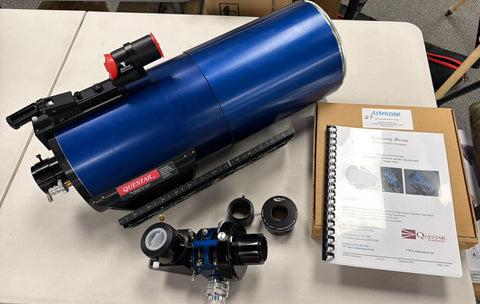
You know it; you love it. You've dreamt about it; you've drooled over it. Now one can finally be yours. We just came into possession of a beautiful SEVEN-INCH 2016 Astro Titianium model Questar with Broadband coatings in magnificent condition. Yup, this is the big boy. In addition to the scope itself, it also includes a Feathertouch dual-speed 2" focuser, so that there's no mirror shift, a TeleVue Starbeam finder, and it comes in a Pelican-style padded foam hard plastic case with wheels and a handlebar.
Mechanically and optically, the scope is in truly excellent condition, with smooth motion of both the built-in Questar focuser and of the Feathertouch focuser. Of course, it has completely clean optics.
It does have some slight marking on the tube, but nothing that noticeable.
Included is an Astrozap full-aperture solar filter. However, it does have some pinhole scratches on one side that will admit the sun, and therefore it is not safe, so YOU MUST NOT USE IT. The PINHOLES make it NOT SAFE. It will damage your eyes if you use it, so don't. We're including it for display and completeness purposes only, as opposed to just throwing it away. If you like, we can throw it away for you.
This is far too large and too expensive to ship; it is available for pickup here at our store.
Questar Serial #P-7-1049-BB-TI-A
- 14" Losmandy D-plate, customized for Q7 bolt pattern, w/ 3 bolts
- Company 7 Operating Manual for Q7
- 2" mirror diagonal with 2"- 1 1/4" adapter
- Moonlight dual-speed focuser to permit dual-speed focusing without moving the mirror, with 2" - 1 1/4" adapter
- Astrozap full aperture WL solar filter (Baader film) (damaged)
- Underwater Kinetics foam-lined hard plastic case
The Questar Seven Astro Titanium
Observe through a Questar Seven Astro, and you'll see detail and clarity in the skies that you have never seen through a lesser scope, or even through many larger scopes. I have compared my own Questar Seven to a 14" Schmidt-Cassegrain on deep space objects such as the Sombrero galaxy, the Saturn Nebula, and Omega Centauri. While the 14" scope was brighter on the fainter objects, the superior contrast and resolution of the Questar Seven was easily visible . . . even to the owner of the 14" scope. The Crêpe Ring and Encke's Division in the rings of Saturn are routine with a Seven in good seeing, as are myriad whorls and festoons in Jupiter's belts and hundreds of sub-kilometer craters on the lunar surface.
What is it about a Questar that lets it outperform larger scopes on a day in/day out basis?
Simply this: a fanatical devotion to hand-crafted accuracy.
Each optical element in a Questar typically tests out at a truly outstanding 1/50th wave accuracy (shaped to within four ten-millionths of an inch of perfection!) This produces guaranteed total system performance at the Cassegrain focus of 1/8th wave or better. That's twice the accuracy needed to meet Lord Rayleigh's Criterion, which specifies the level of optical excellence required to yield visual performance that is indistinguishable from perfect optics.
Most commercial telescopes claim to be "diffraction-limited" (which is generally assumed to mean 1/4th wave accuracy). However, they do not specify whether that is for individual components or the system as a whole. In either case, it's a far cry from the 1/8th wave total system accuracy at the eyepiece of a Questar.
This significant difference in total system accuracy is one reason why a 7" Questar can routinely outresolve a 14" Schmidt-Cassegrain (or virtually any other larger aperture catadioptric or reflector scope) on globular clusters, binary stars, and lunar and planetary details - with the Questar invariably exceeding Dawes' limit for the best resolution available from an optical system of its aperture.
A second reason is the turbulent Earth atmosphere all telescopes must look through. In essence, when observing, you are usually looking through bubbles of disturbed air - microcells typically 4" in diameter in the layer of the atmosphere nearest the surface of the Earth. The larger the aperture of the scope, the greater the image-blurring effect of these microcells, as the larger scopes simply have to look through more of these turbulent cells than a smaller scope.
Finally, there is the matter of contrast. The small secondary mirror of a Questar Seven Maksutov (only 1.87" in diameter) scatters far less light than a 14" Schmidt-Cassegrain's much larger 4.5" secondary. The same holds true with any other larger reflector or catadioptric telescope you care to name. They all have larger light-scattering secondary or diagonal mirror obstructions than a 7" Questar Astro. In addition, a Questar's central baffle tube is not merely black plastic or painted black to reduce reflections, as with lesser scopes, but is a centerless ground stainless steel tube, anodized matte black and containing a wire helix with 19 internal knife-edge baffles to eliminate low-angle reflections that no paint alone can stop. The result is that a Questar scatters less light from the bright areas of an image into the dark - crisply defining high contrast planetary and lunar details that a larger scope can wash out in a haze of scattered light.
A large aperture scope does have greater light-gathering than a 7" Questar to capture additional faint deep space objects from a dark sky site. However, the higher contrast of a Questar lets the multitude of galaxies and nebulas within its grasp stand out more distinctly against a darker sky background, particularly from light-polluted suburban or city sites where a larger scope's greater light-gathering capacity submerges subtle low-contrast deep space details in a fog of city light.
As a Rolls-Royce is to automobiles, so is a Questar to telescopes - the very finest hand-crafted optical performance that money can buy.
The Questar Astro is precision-fabricated of lightened aluminum and titanium components, black and blue anodized for long life. It has a 1" diameter knurled anodized aluminum focusing knob on the rear cell. The knob focuses the scope by turning a spring-loaded 32-pitch stainless steel focus rod that acts directly on the mirror thimble to move the primary mirror within the optical tube. A precision linear rotor bearing, integrated with the mirror mounting, is matched to central tube thimble to minimize mirror shift when focusing.
The Seven Astro uses a 7" diameter meniscus corrector lens of Grade A BK7 optical glass, with magnesium fluoride anti-reflection coatings for high light transmission and minimal reflected light loss. The 7.6" diameter primary mirror is Pyrex, aluminized, with a silicon monoxide (quartz) overcoating for long life.