



Celestron
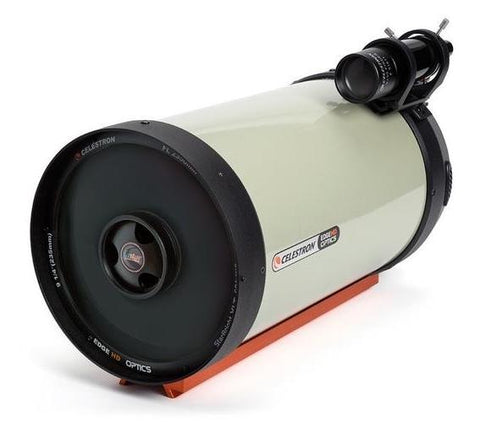
Celestron EdgeHD 925 9.25" Aplanatic Schmidt-Cassegrain Optical Tube
SKU: 91040-XLT
Yes, our inventory is accurate!
 Qualifies for Free Ground Economy Shipping (CONUS Only)
A 9.25-inch astrograph with flat-field stars to the corners
Why we like the EdgeHD 9.25:
- Round stars across the whole frame: the aplanatic EdgeHD optics correct the coma and field curvature that a standard Schmidt-Cassegrain shows at the edges. Celestron rates the focal plane more than three times flatter than a standard SCT, so a large camera sensor stays sharp to the corners.
- Long focal length in a short tube: 2350mm at f/10 in a 22-inch, 21 lb tube. That's the image scale you want for small galaxies, planetary nebulae, the Moon and planets.
- Built for imaging: mirror locks hold the primary still during long exposures, and filtered vents in the rear cell let the mirror cool down faster.
- Worth knowing: 2350mm is demanding. You'll need a solid mount, good polar alignment and autoguiding, and exposures at f/10 are long. If you want a wider, faster field, add the matching 0.7x EdgeHD 925 reducer.
The Celestron EdgeHD 9.25" Optical Tube Assembly (CGE dovetail) is a 235mm (9.25") f/10 aplanatic Schmidt-Cassegrain for deep-sky imaging and high-power visual observing. Many SCT owners consider the 9.25 the best-corrected tube in Celestron's line, and the EdgeHD version adds a flat field for today's large camera sensors. This is the optical tube only, on a Losmandy-style CGE dovetail bar, so you can pair it with the mount that fits the way you observe. It comes with a 9x50 finderscope, a 2" mirror diagonal and a wide-angle 23mm Luminos 2" eyepiece.
Key specs: 235mm (9.25") aperture · 2350mm focal length · f/10 (f/7 with the 0.7x reducer) · EdgeHD aplanatic flat-field optics · StarBright XLT coatings · 559mm (22") long · 9.53kg (21 lb) · CGE dovetail · Fastar compatible

What you can see and image
- Small galaxies: the Whirlpool Galaxy (M51), the Sombrero Galaxy (M104), the Leo Triplet and NGC 891 fill the frame at 2350mm.
- Planetary nebulae: the Ring Nebula (M57), the Cat's Eye (NGC 6543), the Dumbbell (M27) and the Eskimo Nebula (NGC 2392).
- Globular clusters: M13 in Hercules and M3 resolve to the core with good seeing.
- Planets and the Moon: Jupiter's belts and moons, Saturn's rings, Mars near opposition and close-up lunar craters, at high power or with a planetary camera such as the ZWO ASI585MC.
- Visual observing: the included 23mm Luminos gives 102x with a wide 82° field, a good starting view for clusters and the Moon.
How the EdgeHD is different from a standard SCT
A regular Schmidt-Cassegrain has a curved focal plane and some coma, so stars near the edge of a camera sensor go soft and comet-shaped. The EdgeHD adds corrector lenses near the back of the tube that flatten the field and remove the coma. Celestron tests every EdgeHD with a camera and an artificial star before it ships.
- Three ways to image: native f/10 for small targets and planets; f/7 at 1645mm with the 0.7x EdgeHD 925 reducer, which Celestron says keeps the same 146mm back focus as at f/10 and covers a 42mm image circle; or about f/2 with a third-party Fastar lens that replaces the secondary mirror.
- Mirror locks: once you've focused, the locks keep the primary mirror from shifting as the telescope tracks across the sky. For fine focus during imaging, most owners add an electronic focuser on the back.
- Cooling vents: mesh-filtered vents in the rear cell let warm air out from behind the mirror without letting dust in.
Field of view with an APS-C camera: with a ZWO ASI2600MC Pro (23.5 × 15.7mm sensor), the EdgeHD 9.25 covers about 34 × 23 arcminutes at f/10 (0.33″ per pixel). With the 0.7x reducer that grows to about 49 × 33 arcminutes (0.47″ per pixel).

What to add for the best results
- A mount (required): the tube weighs 21 lb before cameras and accessories. For imaging, the Celestron CGEM II (40 lb capacity), the ZWO AM5N (33 lb without a counterweight) or the ZWO AM7 (44 lb without a counterweight) are good matches. All of them take the CGE (Losmandy-style) dovetail.
- Celestron 0.7x Reducer for EdgeHD 9.25: f/7, a 43% wider field and half the exposure time of f/10.
- T-Adapter for EdgeHD 9.25/11/14 or the 48mm wide T-adapter: threads onto the rear cell to attach a camera at prime focus. The 48mm version is the better choice for full-frame sensors.
- A camera: the ZWO ASI2600MC Pro for deep-sky color, or the ASI585MC for planets and the Moon.
- Guiding: long focal lengths need an off-axis guider, such as the ZWO OAG, or the StarSense Autoguider V2 on Celestron mounts.
- Dew control: the Dew Shield DX for 9.25"–11" or the aluminum dew shield and cap, plus a 9.25" Celestron dew heater ring for cold nights.
- Celestron Deluxe Case for 8"/9.25"/11" SCT or EdgeHD: protects the tube in the car and in storage.
EdgeHD 9.25 vs. EdgeHD 8 vs. C9.25
| EdgeHD 8 | EdgeHD 9.25 | C9.25 SCT | |
|---|---|---|---|
| Aperture | 203mm (8") | 235mm (9.25") | 235mm (9.25") |
| Focal length | 2032mm, f/10 | 2350mm, f/10 | 2350mm, f/10 |
| Flat-field, coma-free optics | Yes | Yes | No (standard SCT) |
| With Celestron reducer | 1422mm, f/7 (0.7x EdgeHD 800) | 1645mm, f/7 (0.7x EdgeHD 925) | About f/6.3 (f/6.3 reducer/corrector) |
| Tube weight | 6.35kg (14 lb) | 9.53kg (21 lb) | 9.07kg (20 lb) |
| Included eyepiece | 40mm 1.25" (51x) | 23mm Luminos 2" (102x) | 25mm 1.25" (94x) |
| Best for | An EdgeHD that mid-size mounts can carry | More aperture and focal length for small targets | Visual, planetary and HyperStar imaging on a budget |
See all Celestron EdgeHD telescopes and Schmidt-Cassegrain telescopes.
What's in the box
- EdgeHD 9.25" f/10 optical tube with StarBright XLT coatings
- CGE (Losmandy-style) dovetail bar
- 9x50 finderscope with bracket
- 2" mirror star diagonal with 1.25" adapter
- 23mm Luminos 2" eyepiece (102x)
The mount, reducer, T-adapter, camera and dew control are sold separately.
Celestron EdgeHD 9.25 FAQ
Is the EdgeHD 9.25 good for beginners?
It's easy to use visually, but it's a tube for people who already know what they want to image. At 2350mm, tracking errors and poor polar alignment show up quickly. If you're new to astrophotography, start with a small refractor on a mount like the ZWO AM5N, then add the EdgeHD when you're ready for small galaxies and planetary nebulae. Come talk to us in the store and we'll help you plan the setup.
What mount do I need?
The tube alone weighs 21 lb, and a camera, guider and dew shield add more, so choose a mount with capacity to spare. For imaging, we suggest the Celestron CGEM II, ZWO AM5N or ZWO AM7. On a strain wave mount, a counterweight helps balance an SCT, which sits far out from the mount.
EdgeHD 9.25 or the standard C9.25?
Both have the same aperture and focal length. The EdgeHD adds flat-field correction and mirror locks for deep-sky imaging with large sensors at f/10 or f/7. The C9.25 costs less and is just as good for visual observing, planetary imaging and HyperStar imaging, where the HyperStar lens does its own field correction.
Can I see Saturn and Jupiter?
Yes. A 9.25" SCT is a classic planetary telescope. Celestron lists 555x as the highest useful magnification, though steady air usually limits you to around 200–300x. A 2x Barlow or a short eyepiece gets you there.
Does it work with HyperStar?
Yes. Every EdgeHD is Fastar compatible, so the secondary mirror can be swapped for a third-party f/2 lens for very fast wide-field imaging.
Specifications
| Optics | |
|---|---|
| Optical design | EdgeHD aplanatic Schmidt-Cassegrain |
| Aperture | 234.95mm (9.25") |
| Focal length | 2350mm (93") |
| Focal ratio | f/10 (f/7 with the 0.7x EdgeHD 925 reducer) |
| Optical coatings | StarBright XLT |
| Secondary mirror obstruction | 85mm (3.35"); 36% by diameter, 13% by area |
| Resolution (Rayleigh / Dawes) | 0.59 / 0.49 arcseconds |
| Light-gathering power | 1127x the unaided eye |
| Limiting stellar magnitude | 14.4 |
| Highest / lowest useful magnification | 555x / 34x |
| Mechanical | |
| Optical tube | Aluminum, with mirror locks and filtered rear-cell vents |
| Optical tube length | 559mm (22") |
| Optical tube diameter | 271.78mm (10.7") |
| Optical tube weight | 9.53kg (21 lb) |
| Dovetail | CGE (Losmandy-style) dovetail bar |
| Fastar compatible | Yes |
| Included accessories | |
| Eyepiece | 23mm Luminos 2" (102x) |
| Star diagonal | 2" mirror diagonal with 1.25" adapter |
| Finderscope | 9x50 |
| Part number | |
| Celestron model / SKU | 91040-XLT |