



Yes, our inventory is accurate!
 Qualifies for Free Ground Economy Shipping (CONUS Only)
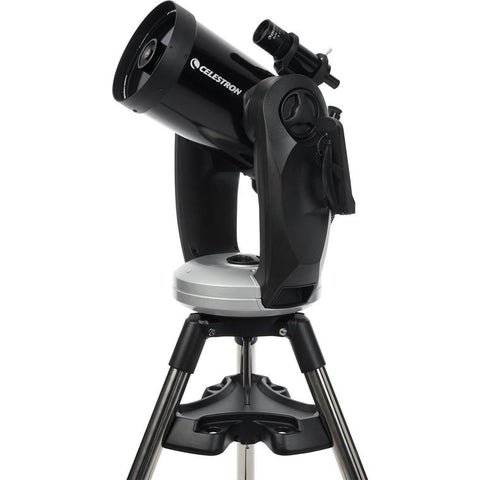
An 8-inch GoTo telescope on a steady dual-fork mount with built-in GPS
Why we like the CPC 800:
- Two fork arms, not one: the tube is held from both sides on a heavy-duty tripod with 2" stainless steel legs, so the view settles quickly when you focus at high power.
- GPS does the setup: the built-in 16-channel GPS reads the date, time and your location. Center three bright stars or planets with SkyAlign and the 40,000-object database is ready to go.
- Room to grow: an autoguide port, two AUX ports, permanent periodic error correction and EQ North alignment let you add a wedge and an autoguider later.
- Worth knowing: the whole kit weighs 61 lb, and the fork mount and tube lift as one 42 lb piece. It needs 12V power from an adapter or power tank, and it has no built-in Wi-Fi.
The Celestron CPC 800 GPS (XLT) Computerized Telescope is an 8" (203mm) f/10 Schmidt-Cassegrain on a computerized dual-fork altazimuth mount. It's for observers who want a big, stable visual telescope that finds objects on its own: planets and the Moon at high power, plus hundreds of galaxies, nebulae and star clusters from a dark site. The tube is 17 inches long, the mount and tube weigh 42 lb (19.1kg) together, and the tripod adds 19 lb (8.6kg).
Key specs: 203mm (8") aperture · 2032mm focal length, f/10 · StarBright XLT coatings · dual-fork altazimuth GoTo mount · internal 16-channel GPS · 40,000+ object database · 9 slew speeds up to 5°/second · 12V DC

What you'll see
- Saturn and Jupiter: Saturn's rings and the Cassini Division, Jupiter's cloud belts and the Great Red Spot, and the four Galilean moons.
- Mars and Venus: Mars's polar caps and dark markings near opposition, and the phases of Venus.
- The Moon: craters, rilles and mountain ranges along the terminator at 150–250x.
- Globular clusters: M13 in Hercules and M5 in Serpens resolve into stars at the edges.
- Nebulae and galaxies: the Orion Nebula (M42), the Ring Nebula (M57), the Dumbbell (M27), the Andromeda Galaxy (M31) and the Whirlpool Galaxy (M51) from a dark site.
- Double stars: Albireo, Epsilon Lyrae (the Double Double) and Mizar.
Why it's easy to set up
- Spread the tripod and set the fork mount on top. Celestron designed the tripod head so you can attach the telescope even in the dark.
- Plug in 12V power, attach the finderscope, diagonal and eyepiece, and turn it on.
- The GPS finds your location and the time. Choose SkyAlign and center any three bright objects; you don't need to know their names.
- Pick a target from the hand control's menus and the telescope slews there and tracks it.
The control panel in the base has ports for the hand control, two AUX ports, a PC port and an autoguide port, plus the power switch and 12V input. The hand control's USB port connects to a computer for planetarium software and firmware updates.

What to add for the best results
- 12V power (required): the Celestron 2A AC adapter for backyard use, or the PowerTank Lithium Pro for dark-sky trips.
- Eyepieces: the included 40mm gives 51x. Add an X-Cel LX 25mm (81x) for clusters and an X-Cel LX 12mm (169x) or Luminos 10mm (203x) for planets.
- EclipSmart Solar Filter for 8" SCT: for safe white-light views of sunspots. Never point the telescope at the Sun without it.
- Planetary imaging: a camera such as the ZWO ASI585MC slides into the 1.25" diagonal or visual back in place of an eyepiece.
- T-Adapter for SCT: attaches a camera body with a T-ring for short-exposure Moon and planet shots.
- Celestron Wedge HD Pro: tilts the fork mount to the celestial pole for long-exposure deep-sky imaging and autoguiding.
CPC 800 vs. NexStar Evolution 8 vs. NexStar 8SE
| CPC 800 GPS | NexStar Evolution 8 | NexStar 8SE | |
|---|---|---|---|
| Optics | 8" f/10 SCT, StarBright XLT | 8" f/10 SCT, StarBright XLT | 8" f/10 SCT, StarBright XLT |
| Mount | Dual fork arm | Single fork arm | Single fork arm |
| GPS | Built in | No | No |
| Wi-Fi | No | Built in | No |
| Power | 12V DC (external) | Built-in lithium battery | 8 AA batteries or 12V DC |
| Autoguide port | Yes | No | Yes |
| Finderscope | 9x50 | Red dot | StarPointer red dot |
| Total kit weight | 27.6kg (61 lb) | 18.4kg (40.5 lb) | 14.5kg (32 lb) |
| Best for | The steadiest view, set up in one spot | Phone control and no cables | The lightest 8" GoTo |
See all Schmidt-Cassegrain telescopes.
What's in the box
- CPC 800 optical tube on the computerized dual-fork mount with GPS
- NexStar hand control
- Heavy-duty tripod with accessory tray
- 40mm 1.25" eyepiece (51x)
- 1.25" star diagonal
- 9x50 finderscope with bracket
- Instruction manual

The power supply, wedge and extra eyepieces are sold separately.
Celestron CPC 800 FAQ
Is the CPC 800 good for beginners?
Yes, if you can handle the weight. The GPS and SkyAlign make the computer setup easier than on most GoTo telescopes, and the dual fork is very stable. The 42 lb fork and tube is the heaviest single piece to carry, so if you'll move it often, look at the NexStar Evolution 8 or 8SE instead.
Can I see Saturn and Jupiter?
Yes. An 8" SCT is one of the classic planetary telescopes. Saturn's rings and Jupiter's belts show clearly at 150–200x, and Celestron lists 480x as the highest useful magnification on the steadiest nights.
CPC 800 or NexStar Evolution 8?
Both have the same 8" optics. The CPC 800 adds GPS, a second fork arm, a 9x50 finder and an autoguide port. The Evolution 8 is lighter, has a built-in battery and Wi-Fi for phone control, and needs no cables.
What power do I need?
The CPC runs on 12V DC at 1.5A, tip positive. Use the Celestron AC adapter at home or a 12V power tank in the field. No power supply is included.
Can I use it for astrophotography?
For the Moon and planets, yes: a planetary camera in place of the eyepiece works well on the altazimuth mount. For long-exposure deep-sky imaging, an alt-az mount causes field rotation, so you'll want the Wedge HD Pro and an autoguider, or a German equatorial mount.
Specifications
| Optics | |
|---|---|
| Optical design | Schmidt-Cassegrain |
| Aperture | 203.2mm (8") |
| Focal length | 2032mm (80") |
| Focal ratio | f/10 |
| Optical coatings | StarBright XLT |
| Secondary mirror obstruction | 64mm (2.5"); 31% by diameter, 9.77% by area |
| Resolution (Rayleigh / Dawes) | 0.69 / 0.57 arcseconds |
| Light-gathering power | 843x the unaided eye |
| Limiting stellar magnitude | 14 |
| Highest / lowest useful magnification | 480x / 29x |
| Optical tube length / diameter | 432mm (17") / 238mm (9.37") |
| Mount and electronics | |
| Mount type | Computerized altazimuth dual fork arm |
| GPS | Internal, 16-channel |
| Database | 40,000+ objects, 100 user-defined objects, enhanced information on over 200 objects |
| Alignment | SkyAlign, Auto Two-Star, Two-Star, Solar System, EQ North and EQ South Align |
| Slew speeds | 9, up to 5°/second |
| Tracking rates / modes | Sidereal, solar and lunar / Alt-az, EQ North and EQ South |
| Motor drive | DC servo motors |
| Periodic error correction | Yes |
| Ports | 2 AUX, autoguide, PC; USB on hand control |
| Hand control | 2-line × 18-character backlit LCD, 19 backlit buttons |
| Power | 12V DC, 1.5A, tip positive |
| Software | Celestron Starry Night Special Edition and SkyPortal app |
| Physical | |
| Mount and optical tube weight | 19.1kg (42 lb) |
| Tripod | 50.8mm (2") stainless steel legs, accessory tray; 8.6kg (19 lb) |
| Total kit weight | 27.6kg (61 lb) |
| Included accessories | 40mm eyepiece, 1.25" star diagonal, 9x50 finderscope with bracket |
| Part number | |
| Celestron model / SKU | 11073-XLT |