



 Qualifies for Free Ground Economy Shipping (CONUS Only)
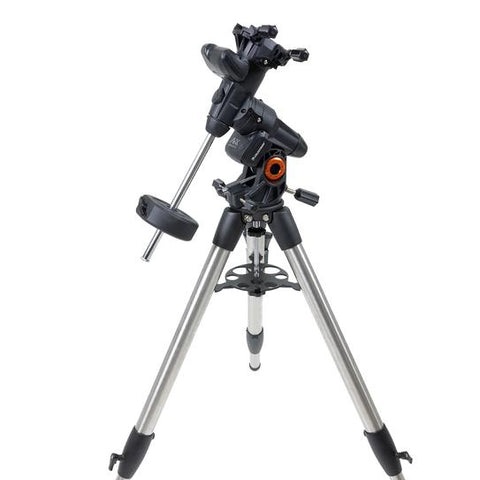
A portable GoTo equatorial mount with the imaging features of bigger mounts
Why we like the Advanced VX:
- Light enough to take places: the head weighs 17 lb (7.7 kg) and the tripod 18 lb (8.2 kg), so one person can carry it out to the backyard or load it in a car for a dark-sky trip.
- Real imaging features: permanent periodic error correction, an autoguider port, two AUX ports and the ability to image across the meridian, for about the price of a mid-range telescope.
- Easy to align: SkyAlign works with any three bright objects, and All-Star Polar Alignment uses any bright star, so you don't need to see Polaris.
- Worth knowing: 30 lb (13.6 kg) is its limit. It's at its best with a small refractor or an SCT up to 8". The saddle takes CG-5 (Vixen) and Celestron CGE dovetails, but not Losmandy D plates.
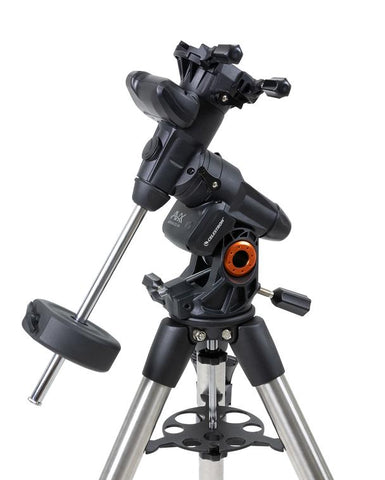
The Celestron Advanced VX (AVX) Computerized Equatorial Mount is the smallest of Celestron's German equatorial mounts. It's built for telescopes up to 30 lb and gives you computerized GoTo and tracking for visual observing, plus the features you need to start long-exposure astrophotography. It comes with a 2" stainless steel tripod, a 12 lb counterweight and the NexStar+ hand control. Pair it with a small apochromatic refractor for a portable imaging rig, or an 8" SCT for planets and galaxies.
Key specs: 30 lb (13.6 kg) payload, not counting counterweights · dual CG-5 and CGE saddle · 7°–77° latitude range · DC servo motors, 9 slew speeds up to 4°/s · permanent PEC and autoguider port · 12V DC, 3.5A · 17 lb (7.7 kg) head, 47 lb (21.3 kg) full kit

What you can see and image
- Nebulae with a small refractor: the Orion, Rosette, Heart, North America and Veil Nebulae with a 50–80mm refractor such as the RedCat 51 and a camera like the ASI2600MC Pro.
- Galaxies: the Andromeda, Triangulum and Whirlpool Galaxies, and M81/M82 in Ursa Major.
- Planets and the Moon with an SCT: Jupiter's cloud belts, Saturn's rings and craters along the lunar terminator with a 6" or 8" SCT such as the EdgeHD 800.
- Star clusters: the Pleiades, the Double Cluster and the Hercules Cluster (M13).
Setting it up
Level the tripod, attach the head and counterweight, slide the telescope into the saddle and balance it. Switching the saddle between narrow CG-5 (Vixen) and wider CGE dovetails is just a matter of moving the clamp knobs to the other set of holes.
Turn it on and use SkyAlign: center any three bright stars, planets or the Moon, and the mount works out where it's pointing. For imaging, run All-Star Polar Alignment from the hand control to fine-tune the altitude and azimuth knobs, and train the permanent periodic error correction once so the mount remembers it.
The mount has a hand control port, two AUX ports for accessories such as the StarSense Autoguider or WiFi module, and an autoguider port. Celestron's free CPWI software connects through the hand control's USB port and adds advanced pointing models and an ASCOM interface for capture programs.

Using the Advanced VX in Colorado
- Dark-sky trips: at 47 lb for the whole kit in three main pieces, it fits easily in a car for a drive out of the Front Range light dome.
- Power in the field: the included DC cable plugs into a car's 12V socket. At home, use the Celestron 2 amp AC adapter.
- Latitude: its 7°–77° range covers all of Colorado (about 37° to 41° north).
What to add for the best results
- A telescope (required): the RedCat 51 for wide-field imaging, or the EdgeHD 800 or C6 SCT optical tubes for planets, the Moon and galaxies.
- Celestron 2 amp AC adapter: runs the mount from a wall outlet. Celestron lists the Advanced VX as compatible.
- StarSense Autoguider: aligns the mount automatically in about three minutes, helps with polar alignment, and autoguides without a separate guide camera or laptop. Plug it into an AUX port, never the autoguider port.
- SkyPortal WiFi module: control the mount from the SkyPortal app on your phone or tablet.
- Advanced VX 11 lb counterweight: a second weight for heavier telescopes.
- CG-5 universal mounting plate: for a telescope or camera that doesn't have a dovetail.
Advanced VX vs. CGEM II
| Advanced VX | CGEM II | |
|---|---|---|
| Payload (not counting counterweights) | 30 lb (13.6 kg) | 40 lb (18 kg) |
| Mount head weight | 17 lb (7.7 kg) | 40 lb (18.1 kg) |
| Tripod weight | 18 lb (8.2 kg) | 20 lb (9 kg) |
| Counterweight included | 1 × 12 lb | 1 × 17 lb |
| Latitude range | 7°–77° | 15°–70° |
| AUX ports (besides hand control) | 2 | 1 |
| Full kit weight | 47 lb (21.3 kg) | 78 lb (35.4 kg) |
| Best for | Small refractors and SCTs up to 8", portable imaging | 8"–11" SCTs and EdgeHDs, heavier imaging rigs |
See all Advanced VX telescopes and mounts.
What's in the box
- Advanced VX equatorial mount head
- 2" stainless steel tripod
- Accessory tray
- 12 lb counterweight
- NexStar+ hand control
- DC power cable (plugs into a car's 12V socket)
The telescope, AC adapter and 12V battery are sold separately.
Celestron Advanced VX FAQ
Is the Advanced VX good for beginners?
Yes. It's one of the most approachable equatorial mounts: SkyAlign and the hand control's menus get you observing in a few sessions, and it has the features you'll want when you start imaging.
Is the Advanced VX good for astrophotography?
Yes, especially with a small refractor. It has permanent PEC, an autoguider port and can image across the meridian. For long exposures, add autoguiding with the StarSense Autoguider or a guide camera, and keep your setup comfortably under the 30 lb limit.
What telescopes fit the Advanced VX?
Anything with a CG-5 (Vixen) or Celestron CGE dovetail, up to 30 lb including accessories. Celestron sells it with refractors, Newtonians, the 6" and 8" RASA, and SCTs up to 11". Losmandy D plates don't fit the saddle.
Advanced VX or CGEM II?
Choose the Advanced VX if you'll move the mount often and your telescope is a refractor or an SCT up to 8". Choose the CGEM II for 9.25" and 11" SCTs, or for an 8" imaging rig with lots of accessories.
What power does it need?
12V DC at 3.5A, tip positive. Use the included cable with a car or 12V power tank, or the Celestron AC adapter at home.
Specifications
| Mount | |
|---|---|
| Mount type | Computerized German equatorial |
| Payload capacity | 30 lb (13.6 kg), not counting counterweights |
| Dovetail saddle | Dual saddle: CG-5 (Vixen, 100mm or longer) and Celestron CGE; not Losmandy D |
| Latitude range | 7°–77° |
| Motors | DC servo motors |
| Slew speeds | 9, up to 4°/second |
| Tracking rates | Sidereal, solar and lunar |
| Tracking modes | EQ North and EQ South |
| Periodic error correction | Yes, permanent |
| Electronics | |
| Hand control | NexStar+ with LCD display, 19 fiber-optic backlit buttons, USB port |
| Database | 40,000+ objects, 100 user-defined objects, enhanced information on 200+ objects |
| Alignment procedures | 2-Star, 1-Star, Quick, Solar System, Last Alignment; SkyAlign; All-Star Polar Alignment |
| Ports | Hand control port, 2 AUX ports, autoguider port; USB on hand control |
| GPS | No |
| Power | 12V DC, 3.5A, tip positive |
| Software | CPWI, Starry Night Special Edition, SkyPortal app |
| Physical | |
| Tripod | 2" (50.8mm) stainless steel legs |
| Height range (mount and tripod) | 1118–1626mm (44"–64") |
| Mount head weight | 17 lb (7.71 kg) |
| Tripod weight | 18 lb (8.16 kg) |
| Counterweight | 1 × 12 lb |
| Total kit weight | 47 lb (21.31 kg) |
| Celestron item number | 91519 |